
Last Updated: October 14, 2026
Introduction to the Hippo Signal Transduction Pathway
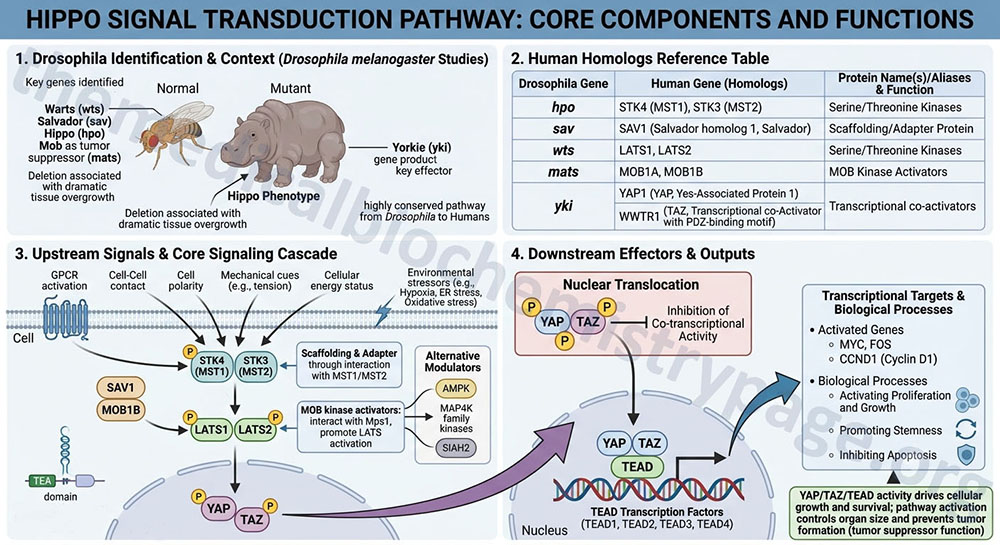
The initial identification, of what has become termed the Hippo signaling pathway, was in Drosophila melanogaster studies looking for novel tumor suppressors. In these studies the deletion of the genes identified as Warts (wts), Salvador (sav), Hippo (hpo), and Mob as tumor suppressor (mats) was associated dramatic overgrowth of multiple tissues leading to the generation of mutant fly embryos resembling the hippopotamus.
Numerous subsequent studies demonstrated that the proteins encoded by these genes interacted, thus forming a novel signal transduction network identified as the Hippo pathway. The Hippo pathway components have been found to be highly conserved, with homologs of each Drosophila gene being expressed in mammals, including humans.
Additional studies identified a gene identified as Yorkie (yki) whose encoded protein interacted with the wts encoded proteins. The yki encoded protein was found to be a key effector of the proteins in the Hippo pathway.
The Hippo signaling network has been found to function in processes that regulate cell proliferation, apoptosis, and stemness. These effects of the Hippo signaling pathway occur in response to a wide range of extracellular and intracellular signals, including cellular energy status, G-protein coupled receptor (GPCR) activation, cell-cell contact, cell polarity, and various mechanical cues.
The Hippo Signaling Network Genes in Humans
Human hpo Homologs: STK3 (MST2) and STK4 (MST1)
Humans express two homologs of the hpo gene identified as serine/threonine kinase 3 (STK3) and STK4. The STK3 encoded protein is also commonly identified as mammalian sterile 20-like 2 (MST2). The STK4 encoded protein is commonly identified as MST1. As the name of these two genes indicates, the STK3 and STK4 encoded proteins (MST2 and MST1, respectively) are kinases.
The STK3 gene is located on chromosome 8q22.2 and is composed of 24 exons that generate three alternatively spliced mRNAs, each of which encode a distinct protein isoform.
The STK4 gene is located on chromosome 20q13.12 and is composed of 15 exons that generate two alternatively spliced mRNAs encoding proteins of 487 amino acids (isoform 1) and 462 amino acids (isoform 2).
Human sav Homolog: Salvador
The human homolog of the sav gene is identified as salvador family WW domain containing protein 1 (SAV1). The SAV1 encoded protein is most commonly identified as salvador homolog 1, or simply as salvador. The primary function of the SAV1 encoded protein is serving as a scaffolding and adapter protein through its interactions with the STK3/MST2 and STK4/MST1 kinases.
The SAV1 gene is located on chromosome 14q22.1 and is composed of 7 exons that encode a protein of 383 amino acids.
Human wts Homologs: LATS1 and LATS2
Humans express two homologs of wts gene identified as large tumor suppressor kinase 1 (LATS1) and LATS2. The LATS1 and LATS2 encoded proteins are serine/threonine kinases.
The LATS1 gene is located on chromosome 6q25.1 and is composed of 18 exons that generate five alternatively spliced mRNAs, each of which encode a distinct protein isoform.
The LATS2 gene is located on chromosome 13q12.11 and is composed of 12 exons that encode a protein of 1088 amino acids.
Human mats Homologs: MOB1A and MOB1B
Humans express two homologs of the mats gene identified as MOB kinase activator 1A (MOB1A) and MOB1B. The term MOB stems from the identification of a yeast protein that interacted with a kinase identified as Mps1 and thus, was termed Mps One Binder.
The MOB1A gene is located on chromosome 2p13.1 and is composed of 7 exons that generate four alternatively spliced mRNAs, each of which encode a distinct protein isoform.
The MOB1B gene is located on chromosome 4q13.3 and is composed of 10 exons that generate three alternatively spliced mRNAs, each of which encode a distinct protein isoform.
Human yki Homologs: YAP and TAZ
There are two highly related genes (paralogs) in humans that perform the functions identified for the Drosophila yki gene. The genes are identified as YAP1 (Yes-Associated Protein 1) and TAZ (Transcriptional co-Activator with PDZ-binding motif). The human TAZ homolog is encoded by the WWTR1 (WW domain containing transcription regulator 1) gene. The term PDZ is derived from the three genes in which the domain was original identified, PSD-95 (post-synaptic density-95; a rat protein identified as a core scaffolding protein in the nervous system), Dlg (discs large; a Drosophila tumor suppressor), and ZO-1 (zonula occludens-1; a tight junction protein).
Because they share similar sequences and overlapping functions, they are often grouped together as YAP/TAZ. However, it is important to recognize that they do have distinct differences in their structure and biological roles. The YAP and TAZ encoded proteins both function as transcriptional co-activators, and as such serve as the critical downstream effectors of the signaling processes that are initiated by the activation of the components of the Hippo signaling pathways.
The ultimate consequences of the activation of upstream signaling processes of the Hippo pathway is inhibition of the co-transcriptional activity of the YAP and TAZ proteins. YAP and TAZ exert their co-transcriptional effects through transcription factors of the TEAD (TEA domain) family. The TEA domain refers to a domain originally identified in two proteins, TEF-1 (Transcriptional Enhancer Factor 1) and AbaA (a fungi gene identified as abacus A). There are four human TEAD transcription factors identified as TEAD1, TEAD2, TEAD3, and TEAD4.
The majority of YAP/TAZ/TEAD transcriptionally activated genes encode proteins that are involved in activating proliferation and growth as well as inhibiting apoptosis. Several noted target genes, whose encoded proteins influence growth and proliferation, include MYC, FOS, and CCND1 (encoding cyclin D1).
As discussed in the sections below, YAP and TAZ activity also controls expression of numerous genes whose encoded proteins are involved in a wide array of metabolic processes.
The YAP1 gene is located on chromosome 11q22.1 and is composed of 11 exons that generate nine alternatively spliced mRNAs, each of which encode a distinct protein isoform.
The WWTR1 gene is located on chromosome 3q25.1 and is composed of 16 exons that generate four alternatively spliced mRNAs, all of which encode the same 400 amino acid protein.
Core Processes of the Hippo Signaling Pathway
Numerous upstream events, that reflect cellular responses to environmental stressors and/or conditions that are not favorable for cellular growth, include mechanical stresses, GPCR activation, oxidative stress, endoplasmic reticulum (ER) stress, and hypoxia. In the context of the Hippo signaling pathway, these events lead to the phosphorylation, and thus activation, of the kinase activities of the STK3 (MST2) and STK4 (MST1) kinases. These two kinases are complexed with the scaffolding protein encoded by the SAV1 gene.
Following the activation of the kinase activity of STK3(MST2) and STK4(MST1), in conjunction with the Salvador 1 scaffolding protein, these kinases phosphorylate the LATS1 and LATS2 kinases resulting in their activation. The activation of LATS1 and LATS2 also involves their interaction with the mats homologs, MOB1A and MOB1B. Activation of LATS1 and LATS2 results in the phosphorylation of YAP and TAZ which results in their retention in the cytosol preventing their ability to interact with and activate the TEAD family transcription factors in the nucleus. Retention of phosphorylated YAP and TAZ in the cytosol results in their ubiquitylation and degradation in the proteasome.
The net effect of the Hippo signaling pathway is that when the pathway is turned on, YAP and TAZ are unable to function as nuclear-localized transcriptional activators which results in reduce cellular proliferation and growth. Conversely, when the Hippo pathway is inactive, YAP and TAZ can accumulate in the nucleus, interact with TEAD family transcription factors, and lead to enhanced proliferation and growth and inhibited apoptosis.
Although the foundation of the Hippo signaling pathway involves events that lead to the activation of STK4/STK3 (MST1/MST2) as the initiating process, there are numerous modulators that can act downstream of STK4/STK3 resulting in inhibition of the co-transcriptional activity of YAP/TAZ. These modulators include, but is not limited to, AMPK, various MAP4K family kinases, and SIAH2 [seven in abstentia (Sia) homolog (SIAH) 2] which belongs to the family of ubiquitin ligases. When activated under conditions of low energy, AMPK will directly phosphorylate YAP and TAZ. Members of the MAP4K family of kinases can directly phosphorylate LATS1 and LATS2, thus bypassing the upstream STK3 and STK4 kinases. Under conditions of hypoxia, SIAH2 activation leads to ubiquitylation of LATS1 and LATS2, thus leading to their degradation and a resultant loss of the inhibition of YAP and TAZ.
Another upstream regulator of the Hippo signaling network is the scaffolding protein identified as angiomotin (encoded by the AMOT gene). Alternative splicing of the AMOT mRNA results in a full-length angiomotin protein identified as Amot-p130, and an N-terminally truncated isoform identified as Amot-p80. The function of the angiomotin proteins in the Hippo signaling pathway is the sequestration of YAP and TAZ in the cytosol so that they cannot engage in nuclear transcriptional co-activation.
Hippo Signaling and Regulation of Metabolic Processes
Following the identification of the role of the Hippo signaling pathway in processes related to the regulation of tissue growth, numerous metabolic process were identified that were critical to the regulation of the Hippo signaling network. These metabolic processes include glucose homeostasis, fatty acid metabolism, and synthesis of intermediates (mevalonate pathway) in the pathway leading to cholesterol synthesis.
Hippo Signaling and Glucose Homeostasis
Glucose metabolism is the major source of ATP energy from carbon oxidation, despite provided less overall moles of ATP per mole of carbon atom. The major metabolic utility of glucose oxidation is that it can proceed with the generation of two moles of ATP per mole of glucose, even in the absence of oxygen. Amino acid and fatty acid oxidation are incapable of oxygen-free ATP generation. Thus, it is not surprising that glucose metabolism provides one of the most direct routes by which nutrient availability regulates Hippo signaling and the regulation of metabolic gene expression. Conversely, the Hippo signaling pathway regulates the expression of genes whose encoded proteins influence both glucose uptake and downstream carbon utilization via glycolysis and the diversion of glucose carbons into other metabolic substances.
When glucose is limiting, the resultant reduction in ATP concentration leads to the activation of AMP-activated protein kinase (AMPK). AMPK directly suppresses the transcriptional co-activator activities of YAP and TAZ via direct inhibitory phosphorylation. AMPK also phosphorylates angiomotin (AMOT) which stabilizes the protein allowing it to actively sequester YAP and TAZ in the cytosol. Angiomotin also directly interacts with, and stabilizes, the LATS1 and LATS2 kinases enhancing their kinase activity which promotes YAP and TAZ phosphorylation in the cytosol, further restricting YAP and TAZ migration into the nucleus.
Oxidation of glucose, via glycolysis, can directly modulate Hippo signaling. As the rate of glycolysis increases there is a consequent enhancement of YAP and TAZ activation that is independent of the levels of ATP. The glycolytic enzyme, phosphofructokinase-1 (PFK1) has been shown to interact with TEAD family transcription factors which leads to a stabilization of the transcriptionally active complexes of YAP/TAZ/TEAD which leads to enhanced transcriptional activity at TEAD target genes. Glycolytic intermediates, downstream of the aldolase A (ALDOA)-catalyzed reaction, are known to suppress the kinase activity of AMPK. Reduced AMPK activity results in reduced YAP and TAZ phosphorylation and subsequently increased YAP/TAZ/TEAD transcriptional activity.
Increased glucose levels also modulate the Hippo signaling pathway by increasing the concentration of glucose-6-phosphate which is not only a glycolytic intermediate but also the precursor for the synthesis of UDP-GlcNAc via the hexosamine biosynthetic pathway (HBP). UDP-GlcNAc is the substrate for the enzyme O-GlcNAc transferase (OGT) which catalyzes the O-GlcNAc modification (referred to as O-GlcNAcylation: pronounced “Oh glook knack ill ation”) on nuclear and cytoplasmic proteins. The gamut of O-GlcNAcylated proteins includes enzymes involved in the metabolism of amino acids, nucleotides (e.g. thymidine kinase), and carbohydrates (e.g. glucose-6-phosphatase), regulating overall metabolic processes (e.g. AMPK), cell growth and maintenance (e.g. MYC, Sp1, β-catenin), DNA damage responses, intracellular transport, transcription (e.g. RNA polymerase II), and translation (e.g. eIF-5). The carboxy-terminal domain of a subpopulation of RNA polymerase II is extensively O-GlcNAcylated, and almost all RNA polymerase II transcription factors are O-GlcNAcylated.
The O-GlcNAcylation of YAP, particularly under conditions of high glucose, results in its stabilization. The O-GlcNAcylated YAP is less likely to be phosphorylated by LATS1 and LATS2 which further stabilizes the ability of YAP to function as a transcriptional co-activator. The angiomotin protein is also subject to O-GlcNAcylation, the consequences of which are further promotion of YAP and TAZ stability and consequent transcriptional co-activation.
Hippo signaling through YAP/TAZ/TEAD-mediated transcription results in increased expression of glucose transporters and key glycolytic enzymes. Some of the target genes of the Hippo pathway that are involved in glucose metabolism include SLC2A1 (encodes the GLUT1 glucose transporter), SLC2A2 (encodes the GLUT2 glucose transporter), HK2 (encoded the hexokinase 2 isoform of hexokinase), PFKL (encodes the liver subunit of the PFK-1 enzyme), PFKM (encodes the skeletal muscle subunit of the PFK-1 enzyme), PFKFB3 (encodes what is often referred to as the brain isoform of PFK-2), and LDHA (encodes the lactate dehydrogenase A enzyme). By enhancing glucose metabolism, the glycolytic intermediates that result from modification of the Hippo signaling pathway can be diverted into various anabolic pathways, which results in the coupling of glucose metabolism to amino acid biosynthesis and nucleotide biosynthesis, thereby promoting growth.
In addition to the diversion of glucose-6-phosphate into the HBP, enhanced glycolytic activity, in conjunction with modified Hippo signaling can also direct glucose-6-phosphate into the pentose phosphate pathway (PPP). The major byproducts of the PPP are NADPH and ribose-5-phosphate. The NADPH is a major requirement for reductive biosynthesis as well as ensuring redox balance. Ribose-5-phosphate is required for the synthesis of the nucleotides.
Hippo Signaling and Amino Acid Metabolism
Amino acid availability, most significantly glutamine, represents a critical upstream regulator of Hippo signaling. Under conditions of glutamine deprivation the LATS1 and LATS2 kinases are inhibited as a result of reactive oxygen species (ROS) activating RhoA which inhibits the kinase activity of the enzymes. The inhibition of the kinase activity of LATS1 and LATS2 under these conditions allows YAP and TAZ to migrate to the nucleus where, in conjunction with TEAD family transcription factors, activate the expression of numerous genes encoding amino acid transporters and amin acid metabolic enzymes.
Conversely, when glutamine levels are elevated, glutamine, in a glutamine synthetase-dependent manner, enhances the stabilization and activation of the LATS kinases leading to phosphorylation of YAP and TAZ. Phosphorylated YAP and TAZ are then retained in the cytosol resulting in decreased TEAD transcription factor activation of transcription. This effect of glutamine on the Hippo pathway functions independent of the STK3 (MST2) and STK4 (MST1) kinases.
Several genes, encoding proteins involved in amino acid metabolism, that are regulated by the Hippo signaling pathway include the SLC family transporters, SLC1A5, SLC3A2, SLC7A5, and SLC38A1.
SLC1A5 encodes a neutral amino acid transporter primarily responsible for plasma membrane glutamine transport. This transporter is also known as ASCT2 (derived from AlaSerCys Transporter 2). A mitochondria-localized variant, SLC1A5_var (MTS-SLC1A5), transports glutamine into and out of the mitochondria.
SLC3A2 encodes encodes a heavy chain subunit of heteromeric amino acid transporters. The protein is also known as 4F2hc (4F2 cell-surface antigen heavy chain). The SLC3A2 encoded heavy chain protein forms heterodimers with the light chain subunits encoded by the SLC7A5 (LAT1), SLC7A6 (y+LAT2), SLC7A7 (y+LAT1), SLC7A10 (ASC1), and SLC7A11 (xCT) genes.
As indicated in the previous paragraph, SLC7A5 encodes the light chain subunit, LAT1 [L-type (or light subunit) amino acid transporter 1], of heteromeric amino acid transporters formed in conjunction with the SLC3A2 encoded heavy chain subunit. This heteromeric transporter transports phenylalanine, tyrosine, and tryptophan into the brain, methionine into T cells, and is a major methionine transporter in cancer cells.
SLC38A1 encodes a member of the sodium–coupled neutral amino acid (system N and system A) transporters (SNAT) identified as SNAT1. SNAT1 is a plasma membrane-localized amino acid transporter. SNAT1 mediates Na+–coupled transport of neutral amino acids with preference for alanine, asparagine, cysteine, glutamine, histidine, and methionine. It also transports glycine and serine into cells.
Among some of the amino acid metabolic genes that are activated by YAP and TAZ under conditions of glutamine deprivation are the GLUL, GLS, GOT1, PSAT1.
The GLUL gene encodes glutamine synthetase with generates glutamine from glutamate in an ATP-dependent reaction.
The GLS gene encodes two glutaminase isoforms that are often referred to as glutaminase C (GAC) and kidney-type glutaminase (KGA) but are collectively the glutaminase 1 (GLS1) enzymes. The GLS encoded isoforms of glutaminase are primarily expressed in the kidneys.
The GOT1 (glutamate-oxaloacetate transaminase 1) gene encodes the cytosolic version of what is most commonly identified as aspartate transaminase (AST). AST catalyzes the reversable reaction converting glutamate and oxaloacetate to aspartate and 2-oxoglutarate (α-ketoglutarate) and the reverse direction.
The PSAT1 gene encodes phosphoserine aminotransferase 1, an enzyme involved in the pathway of the conversion of the glycolytic intermediate, 3-phosphoglycerate, to serine. The PSAT1 encoded enzyme utilizes glutamate as the amino donor and releases 2-oxoglutarate (α-ketoglutarate) during the reaction converting 3-phosphohydroxypyruvate to phosphoserine.
Hippo Signaling and Lipid Metabolism
Various aspects of lipid metabolism, including but not limited to, the isoprenoid intermediates of the cholesterol biosynthesis pathway and bile acid metabolites are additional important metabolic processes that function as upstream regulators of Hippo pathway signaling.
Phosphatidic acids, which are generated by the phosphorylation of diacylglycerols via the action of various diacylglycerol kinases (DGK), or through the metabolism of membrane phospholipids via the actions of phospholipase D family member enzymes, are key regulators of the Hippo signal transduction cascade. Phosphatidic acids interact with the LATS1 and LATS2 kinases which results in disruption of the formation of LATS-MOB1 complexes. This effect of phosphatidic acid prevents the kinases activity of LATS1 and LATS2 from phosphorylating YAP and TAZ which, in turn, allows YAP and TAZ to migrate into the nucleus and interact with TEAD transcription factors.
The initial steps of the pathway of cholesterol biosynthesis, leading to the production of the isoprenoid intermediates geranylgeranyl pyrophosphate (geranylgeranyl-PP) and farnesyl pyrophosphate (farnesyl-PP), are referred to as the mevalonic acid (MVA) pathway. These isoprenoid intermediates are crucial substrates for the post-translational modification of numerous proteins in a process which is broadly referred to as protein prenylation. Geranylgeranyl-PP serves as the substrate for protein geranylgeranylation (GGylation) with many members of the monomeric G-protein family, particularly Ras, Rho, and Rab, requiring this post-translational modification for their cellular function.
The GGylation of Rho family GTPases facilitates their membrane localization and activation. Activated Rho enhances the nuclear localization and activation of YAP and TAZ, an effect that bypasses the canonical STK3(MST2)-STK4(MST1) and LATS1/LATS2 kinase cascade of the Hippo signaling pathway. When the MVA pathway is inhibited, such as is the case with statins treatment of hypercholesterolemia, the reduced level of geranylgeranyl-PP leads to reduce levels Rho GTPase activity. The reduction in Rho GTPase activity promotes YAP and TAZ retention in the cytosol, thereby, resulting in reduced co-transcriptional activation of TEAD target genes.
Bile acids and bile acid metabolism also contribute to modulation of the Hippo signaling network. Bile acids themselves function as signal transduction regulators and in the context of the Hippo pathway they do so by suppressing the activation of the STK3(MST2) and STK4(MST1) kinases, thereby preventing YAP and TAZ phosphorylation which promotes their migration into the nucleus. The synthesis of bile acids is regulated, in part, via the Hippo signaling pathway.
When bile acid level increase they activate the FXR nuclear hormone receptors in the intestines. Activation of FXR results in enhanced expression of the FGF19 gene in intestinal enterocytes which then release FGF19 to the portal circulation. When FGF19 binds to the FGF receptor (FGFR4) on hepatocytes one consequence is the activation of the STK3(MST2) and STK4(MST1) kinases. Activated STK3(MST2) and STK4(MST1) kinases phosphorylate and stabilize the SHP. Activated SHP is a transcriptional repressor of the CYP7A1 gene which encodes the rate-limiting enzyme of de novo hepatic bile acid synthesis.
The Hippo signaling pathway plays a major role in overall lipid metabolism, including lipid synthesis, oxidation, storage, and energy expenditure, via regulation of the expression of numerous genes whose encoded proteins function in these processes. YAP and TAZ cooperate with the members of the sterol regulated element binding protein (SREBP) family of transcription factors (specifically SREBP1 and SREBP2). Lipid metabolism genes that are regulated by YAP and TAZ include, but not limited to, FASN, ACACA, SCD, HMGCR, HMGCS1, FDPS, SQLE, DHCR7, LDLR, and CD36.
The FASN gene encodes fatty acid synthase, the major enzyme of de novo fatty acid synthesis.
The ACACA gene encodes the rate-limiting enzyme of de novo fatty acid synthesis, acetyl-CoA carboxylase 1 (ACC1).
The SCD gene encodes fatty acid desaturase, Δ9-stearoyl-CoA desaturase, commonly referred to simply as stearoyl-CoA desaturase. The SCD encoded enzyme is the rate-limiting enzyme involved in the synthesis of the major monounsaturated fatty acids oleic acid (18:1) and palmitoleic acid (16:1).
The HMGCR gene encodes 3-hydroxy-3-methylglutaryl-CoA (HMG-CoA) reductase (HMGR). HMGR catalyzes the rate-limiting enzyme of cholesterol biosynthesis, converting HMG-CoA to mevalonic acid.
The HMGCS1 gene encodes the cytosolic version of 3-hydroxy-3-methylglutaryl-CoA (HMG-CoA) synthase which converts acetoacetyl-CoA and acetyl-CoA to HMG-CoA which is the second reaction in the cholesterol biosynthesis pathway.
The FDPS gene encodes farnesyl diphosphate synthase which catalyzes the condensation of isopentenyl pyrophosphate (IPP) and dimethylallyl pyrophosphate (DMAP) to generate geranyl pyrophosphate, GPP. GPP further condenses with another IPP molecule to yield farnesyl pyrophosphate, FPP. These reactions constitute a portion of the cholesterol biosynthesis pathway known as the mevalonic acid (MVA) pathway.
The SQLE gene encodes squalene epoxidase which catalyzes the first reaction of the two-step cyclization of squalene to lanosterol in the cholesterol biosynthesis pathway.
The DHCR7 gene encodes NADPH-dependent enzyme, 7-dehydrocholesterol reductase which catalyzes the final step in the cholesterol biosynthesis pathway.
The LDLR gene encodes the LDL receptor.
The CD36 gene encodes a member of the fatty receptor family commonly identified as fatty acid translocase (FAT/CD36). CD36 encoded protein was originally identified a platelet receptor for thrombospondin and pathogenic variants in the CD36 gene are associated with platelet glycoprotein deficiency. The CD36 encoded protein is also known as scavenger receptor B3 (SCARB3 or SR-B3). With respect to fatty acid metabolism, FAT/CD36 is the major protein involved in the uptake of fatty acids by adipocytes, skeletal muscle myocytes, and heart cardiomyocytes. The localization of FAT/CD36 to the plasma membrane is facilitated by S-palmitoylation in the Golgi apparatus.