
Last Updated: July 13, 2026
Introduction to Glanzmann Thrombasthenia
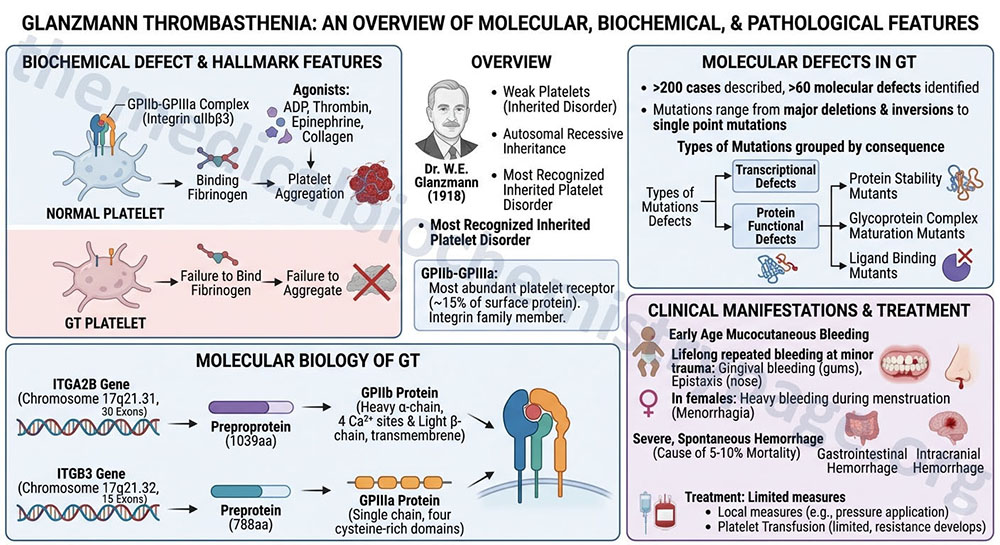
Glanzmann thrombasthenia (weak platelets) is an autosomal recessive disorder affecting the processes of blood coagulation that was originally described in 1918 by the Swiss pediatrician W.E. Glanzmann as a heterogenous group of bleeding disorders. The hallmark of the disease is the failure of platelets to bind fibrinogen and aggregate in the presence of a variety of physiological agonist such as ADP, thrombin, epinephrine or collagen. Although Glanzmann thrombasthenia is a rare disorder it is the most recognized inherited disorder of platelet function.
The underlying defect in all patients with Glanzmann thrombasthenia is an abnormality in the gene encoding either the GPIIb (integrin α2b) or GPIIIa (integrin β3) protein of the GPIIb-GPIIIa complex. The platelet GPIIb-GPIIIa complex is the most abundant platelet receptor representing approximately 15% of the total protein on the surface of platelets. The GPIIb-GPIIIa complex is a member of integrin family of cell surface receptors and as such is also called integrin α2bβ3 (also written as αIIbβ3).
Over 200 individuals have been described as having Glanzmann thrombasthenia and in more than 60 cases the molecular defect has been identified. The molecular abnormalities causing Glanzmann thrombasthenia range from major gene deletions and inversions to single nucleotide variations. These pathogenic variants have been grouped according to the biochemical consequences and include transcriptional and protein functional defects. Among the functional defects there are protein stability mutants, glycoprotein complex maturation mutants and ligand binding mutants.
Molecular Biology of Glanzmann Thrombasthenia
The GPIIb protein is encoded by the ITGA2B (integrin, alpha 2B) gene. The ITGA2B gene is located on chromosome 17q21.31 and is composed of 30 exons that encode a preproprotein of 1039 amino acids. The functional protein exists as a disulfide-linked complex of 871 and 137 amino acid subunits. The larger subunit is extracellular and contains four calcium-binding sites. This subunit is referred to as the heavy- or α-chain. The smaller subunit is referred to as the light- or β-chain and contains the transmembrane domain near it C-terminus.
The GPIIIa protein is encoded by the ITGB3 (integrin beta 3) gene. The ITGB3 gene is located on chromosome 17q21.32 spanning 60 kbp and composed of 15 exons encoding a 788 amino acid preprotein. The protein contains a 26 amino acid leader sequence, four tandemly repeated cysteine-rich domains, and a 29 amino acid transmembrane domain. The GPIIIa protein not only serves as the β-subunit of the platelet GPIIb-GPIIIa complex but also as the β-subunit of the fibronectin receptor and the vitronectin receptor.
Clinical Features of Glanzmann Thrombasthenia
The clinical manifestations of Glanzmann thrombasthenia are significant mucocutaneous bleeding that is evidenced at an early age. Lifelong repeated bleeding at sites of minor trauma such as the gums (gingival) and the nose (epistaxis) is a common feature of Glanzmann thrombasthenia. In females heavy bleeding during menstruation may require therapeutic intervention. Severe intracranial or gastrointestinal hemorrhage can occur spontaneously (i.e. unprovoked by injury) and is a significant cause of mortality in 5% to 10% of Glanzmann thrombasthenia patients. Treatment of the disorder is limited to local measures such as the application of pressure. Platelet transfusion may be useful but only on a limited basis as resistance will develop to the infused platelets.