
Last Updated: June 2, 2026
Introduction to Ataxia Telangiectasia
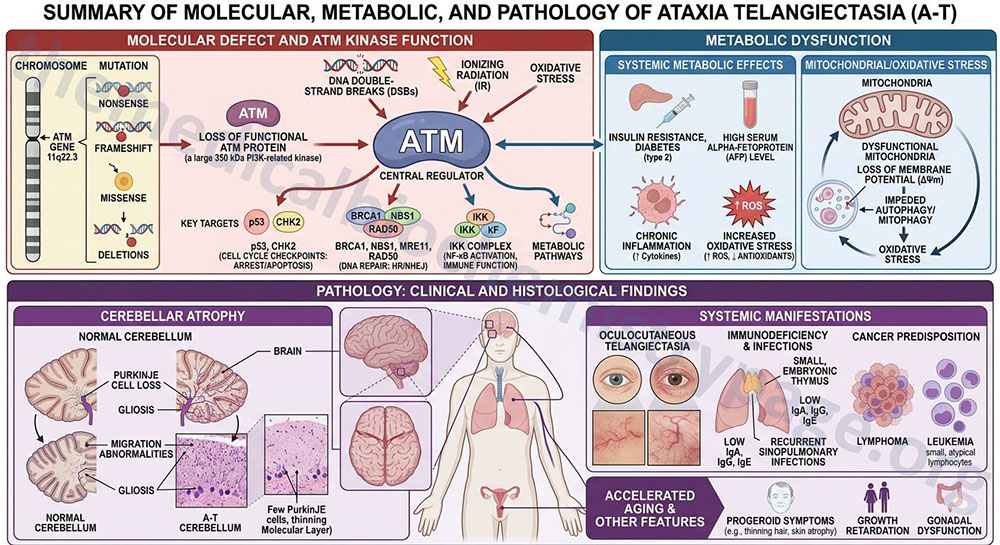
Ataxia telangiectasia (AT) is an autosomal recessive disorder that is characterized by hypersensitivity to ionizing radiation, progressive truncal ataxia affecting the gait with onset by 1 to 3 years of age, slurring of speech, oculocutaneous telangiectasias that begin to develop by age 6, frequent infections and cellular immunodeficiencies, and susceptibility to leukemias and lymphomas.
Telangiectasias are areas of the skin under which there are dilated superficial vessels resulting in an appearance similar to that in patients with rosacea or scleroderma. In addition, as is common in AT, the telangiectasias can develop in the eye. The AT syndrome results from mutations in the ataxia telangiectasia mutated (ATM) gene. There are at least four complementation groups comprising the AT syndrome identified as ATA, ATC, ATD, and ATE all of which result from mutations in the ATM gene.
Molecular Biology of Ataxia Telangiectasia
The ATM gene is located on chromosome 11q22.3 spanning 150kb and comprising 67 exons that generate four alternatively spliced mRNAs collectively encoding two distinct protein isoforms. ATM isoform a is protein of 3056 amino acids with a molecular weight of 350 kDa and this isoform represents the functional ATM protein. ATM isoform b is a protein of 112 amino acids. Expression of the ATM gene is seen in all tissues with highest levels of expression in immune tissues such as spleen and lymph.
The ATM protein is a member of the large molecular weight protein kinase family. Specifically, ATM is a member of the phosphatidylinositol-3-kinase-like (PI3K) family of kinases. The ATM protein also belongs to the large superfamily of armadillo like helical domain containing (ARMH) proteins, of which there are 244 member genes.
The ATM kinase responds to DNA damage (specifically double-strand DNA breaks) by initiating the phosphorylation of several hundred proteins involved in DNA repair and/or cell cycle control. In the presence of mutant ATM, cell cycle arrest does not occur and damaged DNA does not get repaired prior to replication leading to the propagation of potentially cancer causing mutations.
ATM is known to phosphorylate the tumor suppressors p53 (a pivotal protein in cell cycle control) and BRCA1. ATM also phosphorylates IκB-α leading to release of the transcription factor NFκB which is involved in the expression of genes required for immune function as well as processes of synaptic plasticity and memory. In addition, ATM phosphorylates many other proteins involved in the control of cell cycle progression such as the checkpoint kinase CHK2 and the checkpoint proteins RAD17 and RAD9.
The ATM protein also contains a leucine zipper motif in exon 27 indicating the possibility for the protein to form homo- and/or heterodimers. An SH3 domain (SRC homology domain 3) resides from amino acids 1373 to 1382 and is involved in binding of ATM with the tyrosine kinase, ABL, in response to DNA damage.
Clinical Features of AT
AT is a highly pleiotropic disease reflecting the numerous pathways requiring the ATM kinase. The most striking and obvious clinical manifestations seen in AT is progressive cerebellar ataxia. Upon postmortem examination it is observed that there is significant loss of Purkinje cells in the cerebellum. During development the Purkinje cells degenerate and migrate abnormally in the cerebellum. Changes are also seen in the dentate and olivary nuclei along with degeneration in the substantia nigra and neuroaxonal dystrophy in the in the medulla. Additional organ involvement is seen in the thymus which remains embryonic. The growth deficit in the thymus is responsible, in part, for the immunodeficiency seen in AT patients. Many other organs show nuclear changes resulting in nucleomegaly. An additional characteristic observation in 95% of AT patients is an elevation in serum α-fetoprotein (AFP).
Children suffering from AT may begin to learn to walk but will shortly begin to stagger and eventually will be confined to a wheelchair by the age of 10. Two additional classic symptoms in AT patients is slurred speech and oculomotor apraxia (difficulty in moving the eyes from side to side). All teenage AT patients will need help with eating, getting dressed, and using the bathroom. Uncontrolled drooling is a frequent complaint with AT patients. Although neurologic status may appear to improve between the ages of 3 and 7 years, it begins to progressively deteriorate again.
As implied by the name of this disorder, individuals exhibit a typical distribution of telangiectasias. These generally appear between the ages of 4 and 6 years and are found on the conjunctiva of the eye, the bridge of the nose, on the ears, and in the antecubital fossae (the triangular area on the anterior side of the elbow joint).
Approximately 35%–40% of AT patients will develop cancers within their shortened life spans and approximately 85% of these cancers are leukemias or lymphomas. The propensity for cancer in these patients is partly related to the increased frequency of chromosomal translocations seen in AT patients. These translocations involve chromosomes 14q11–q12, 14q32, 7q35, and 7p14.
Treatment for AT is restricted to supportive care. The use of free-radical scavengers is highly recommended and includes vitamin E, coenzyme Q10 (CoQ10), and α-lipoic acid. Daily administration of folic acid has been associated with a reduction in chromosomal breakage in these patients.